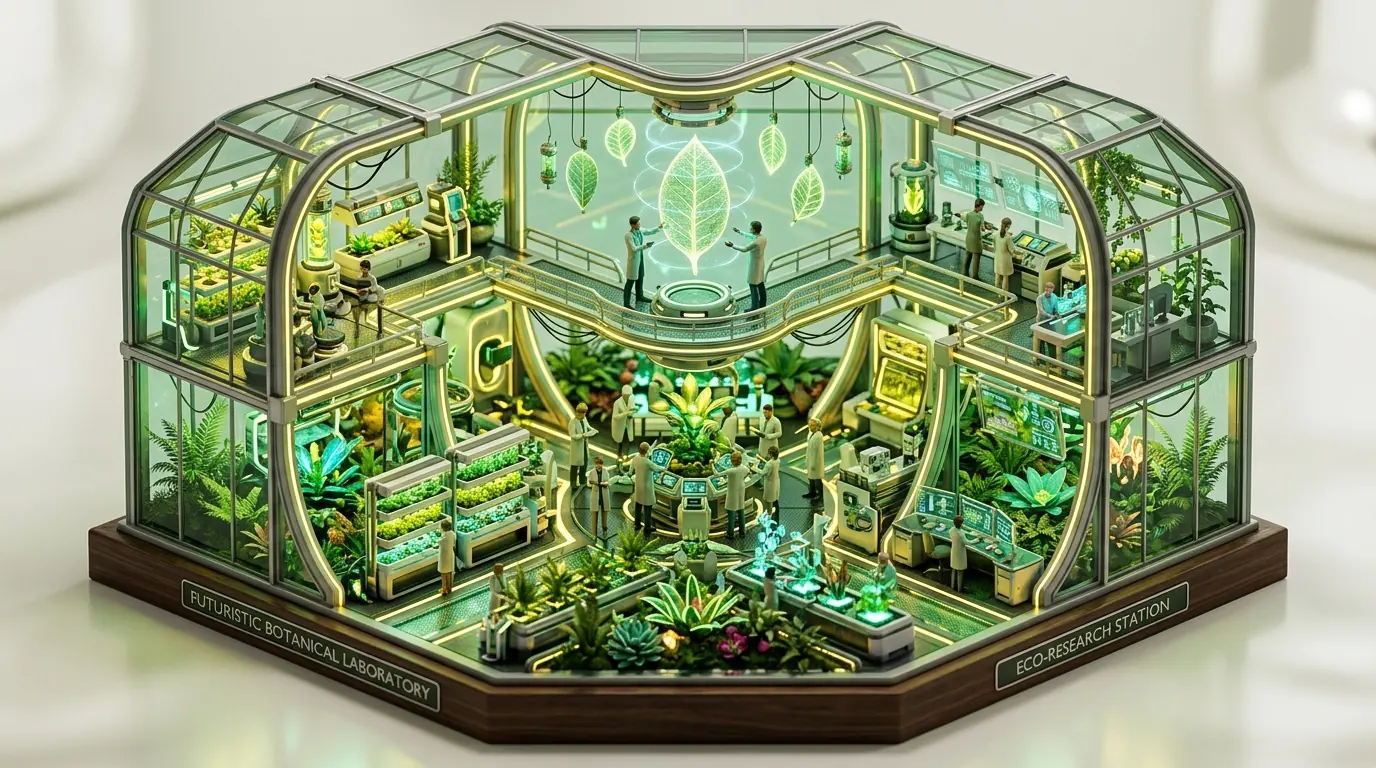
The miniature diorama is the most legible way to explain a system in one image. Scale does the explaining: a person standing beside something they would never really be that size beside tells the viewer instantly what the subject is, and that it has parts.
What the prompt fixes
Interconnected is doing real work here. It is the difference between a diorama and a pile of objects, and it is what makes the image read as a system rather than a scene.
Miniature characters interacting with scaled-up elements sets the scale relationship explicitly, and bright even studio lighting keeps every part of the model legible — which matters when the image will be projected, or printed small. The clean background is what lets it drop onto a slide without cutting out.
Changing it
{{topic}} can be almost anything with components: a process, a building, a piece of software, a laboratory. The more structural the subject, the better this works.
{{palette}} is the one to change for brand fit, and two colours plus a neutral is the sweet spot. {{background}} is usually white, though a light neutral sits better inside a dark deck.
Where it works
Keynote slides, explainer headers, documentation and educational material, at 16:9.
Isometric Educational Diorama
Miniature 3D scene with scaled characters
A miniature diorama concept with scaled characters interacting with an oversized subject. Built for keynote slides, explainer headers and educational content.
Customize
The subject the diorama is built around
Your prompt
285 characterstext, watermark, harsh shadows, cluttered composition